Modernize your IT systems. Preserve the clinical history.
EHR migration, IT convergence across hospital groups (including GHTs in France) or consolidation: CLARYS Medical Memory preserves the medical history and keeps it accessible, whatever the source software.

Your software changes. Clinical memory endures.
A migration should not erase years of history. Medical Memory keeps this information viewable while your new systems take over.
EHR migration. View history without migrating everything into the new EHR.
Multisite convergence. Information from several facilities, gathered around the patient.
Decommissioning. Retire legacy applications once archiving, access and retention are validated.
Rationalization. Reduce dependence on legacy software, at a pace set by your technical and regulatory constraints.
Encounter
Emergency department note
Dr. Ellen Varner
CLARYS Intelligence
A lasting clinical legacy. An information system freer to evolve.
Continuity for professionals
History stays viewable as your information system evolves.
A controlled migration scope
Data migration sized to what the new tool actually needs.
Application costs, revisited
Fewer applications kept running just for viewing: an opportunity to rethink costs.
Multiple systems. One clinical history.
Existing systems
 Interoperability tools and partners · FHIR
 CLARYS Medical MemoryLongitudinal clinical memory, independent of source applications
 CLARYS IntelligenceTraceable understanding of clinical content, linked to sources
Existing systems
Interoperability tools and partners · FHIRCLARYS Medical MemoryLongitudinal clinical memory, independent of source applicationsCLARYS IntelligenceTraceable understanding of clinical content, linked to sourcesYour infrastructure. Your partners. Your freedom.
CLARYS Medical Memory builds on HL7 FHIR and your interoperability tools. Your data, your architecture and your pace remain yours.
- 1
Identify the histories to preserve
Secure the critical histories first, then the rest.
- 2
Connect the available sources
Then connect your live EHRs and other authorized sources.
- 3
Extend the memory to new uses
Finally, turn on semantic understanding and roll out to other facilities.
Preserve the history. Multiply its uses.
After migration, the memory keeps delivering value:
Pathway continuity. A patient context shared across authorized stakeholders.
Clinical summaries. Structured, sourced summaries.
Research and data. Cohorts enriched by historical records, within authorized frameworks.
Trajectories. Comparing patient pathways.
New services. Clinical context for other applications.

 White paper
FHIR-Based Data Archival Solution for Healthcare
Migrate, archive, then retire legacy systems after a merger: Infor’s white paper for the US market.
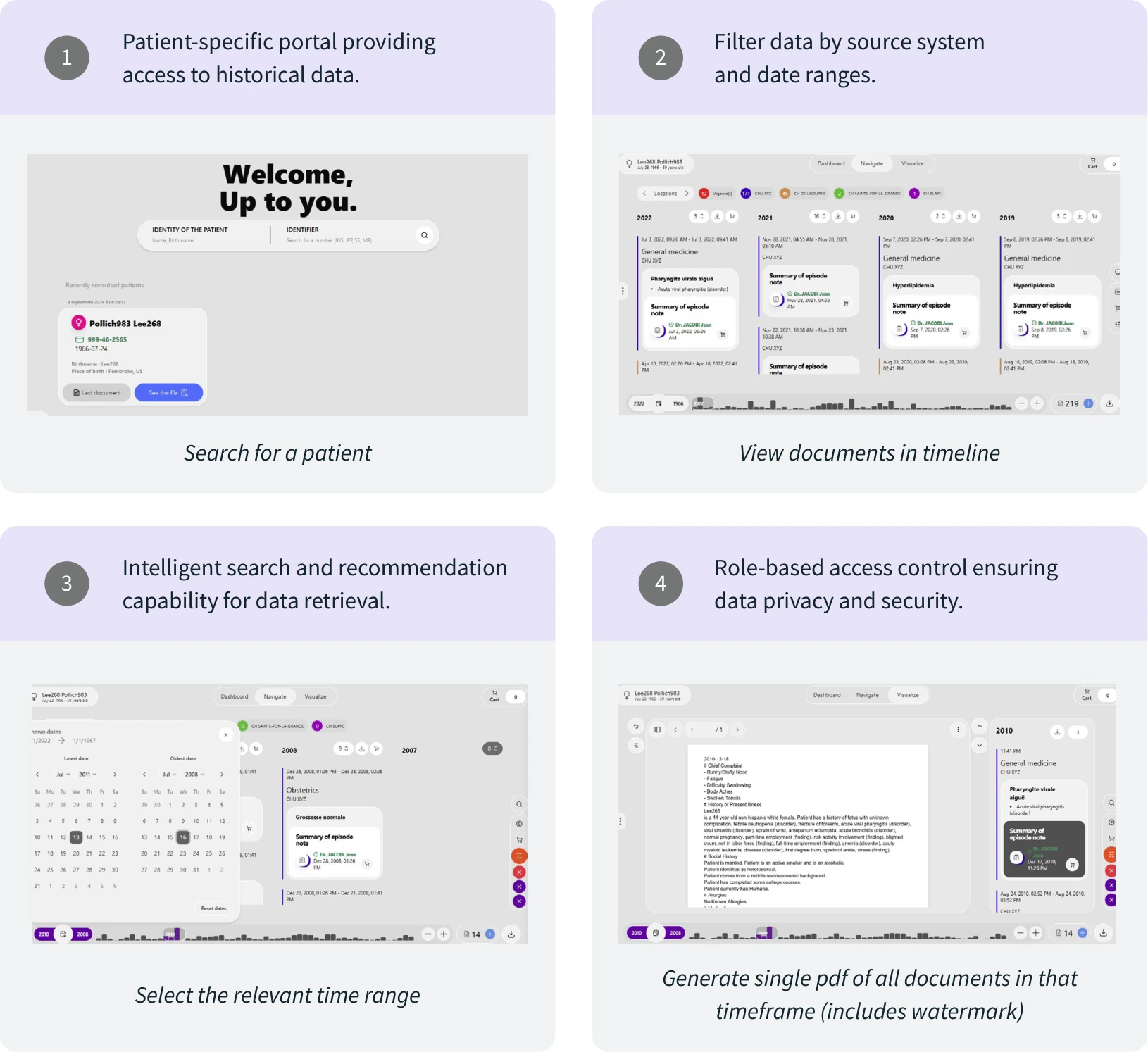
It shows how to normalize legacy data into FHIR once, keep it accessible and retire old applications. The viewer screens shown are CLARYS Medical Memory.
- Migration and archiving on a single FHIR foundation
- Retirement of legacy systems
- Patient access: search, timeline, PDF export
Key takeaways
Change your software without losing the clinical history.
The history stays accessible
During and after migration, whatever the source software.
Fewer applications to maintain
Retire legacy software once archiving and access are validated.
Continuity during outages
The history remains available, even when the EHR is down.
Assess your convergence project on an initial scope.
Let’s identify, on an initial scope, the applications involved, the histories to keep and the potential for rationalization.